

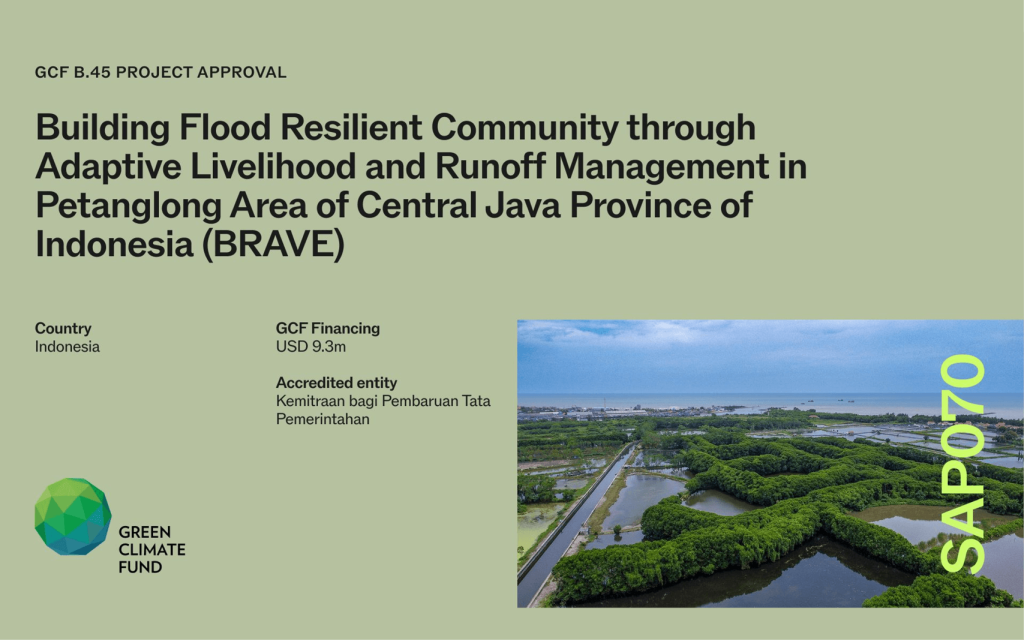
Jakarta, 2 July 2026. Indonesia has, for the first time, been entrusted to directly manage funding from the Green Climate Fund (GCF) after the GCF Board approved a USD 9 million investment for the Building Resilience and Adaptation to Climate Extremes and Disasters (BRAVE) project in the coastal areas of Pekalongan and Batang. This approval makes BRAVE the first project in Indonesia to be financed through the Direct Access Entity (DAE) modality, enabling a national institution to directly access and manage GCF funding.
The coastal areas of Pekalongan and Batang are among the regions most vulnerable to the impacts of climate change in Indonesia. Coastal flooding, shoreline erosion, land subsidence, and increasingly extreme weather continue to threaten settlements, livelihoods, and regional development. Through BRAVE, Indonesia will strengthen community resilience while introducing an adaptation approach that can be replicated in other coastal regions.
Over the next five years, BRAVE will restore and strengthen the resilience of coastal areas through the restoration and management of 3,700 hectares of coastal ecosystems, the development of climate-resilient agriculture- and fisheries-based livelihoods, and the strengthening of adaptation governance. The programme targets 136,360 direct beneficiaries and is expected to reach more than 1.2 million people, the majority of whom are farmers and fishers across the three target areas.
Ruhadia Tama Wicaksono, National Designated Authority (NDA) for the Green Climate Fund at the Ministry of Finance, stated that this approval also reflects Indonesia’s growing capacity to design, manage, and account for climate change projects in accordance with international standards.
“This achievement demonstrates that national institutions are capable of meeting GCF’s international standards while underscoring the importance of national readiness as the primary foundation for accessing climate finance,” said Ruhadia Tama Wicaksono.
Despite the significant funding available, he emphasized that the process requires strong institutional readiness and cross-sector collaboration. Every proposal must comply with stringent requirements, including environmental and social safeguards, accountability mechanisms, and the use of relevant, up-to-date, scientifically sound, and verifiable data.
Ruhadia expressed hope that GCF funding would mark the beginning of stronger implementation of internationally financed climate programmes in Indonesia.
“We hope this achievement will pave the way for more Indonesian institutions to directly access international climate finance in the future,” he said.
At the same time, the project is expected to serve as an example of how collaboration among government agencies, national institutions, civil society, and international partners can be translated into adaptation actions that deliver tangible benefits to communities most vulnerable to climate change.
“This project marks an important milestone, not only for Indonesia but also for the Green Climate Fund. As the first project in Indonesia financed through the Direct Access Entity modality, BRAVE demonstrates how country ownership can be translated into concrete action on the ground,” said Hemant Mandal, GCF Regional Director for Asia and the Pacific.
In addition to Indonesia’s strong commitment to adaptation, GCF’s decision to approve BRAVE was driven by its approach to building business systems that are resilient to extreme weather shocks, enabling them to withstand future climate crises.
“This approach reflects GCF’s commitment to strengthening Indonesia’s leadership in climate action while serving as a long-term partner in building resilience to climate change,” he added.
As the national institution entrusted with managing the funding, Nurina Widagdo, Executive Director of KEMITRAAN, said that this achievement is the result of years of collaboration involving the government, civil society, development partners, and GCF.
“This approval provides Indonesia with an opportunity to demonstrate that national institutions are capable of managing international climate finance in an accountable manner. We are proud to be part of Indonesia’s climate finance history and to contribute to delivering meaningful change for communities affected by climate change,” she said.
Over the next five years, KEMITRAAN will work together with the government, communities, the private sector, Mercy Corps Indonesia as the Executing Entity, and various other partners to implement the BRAVE project across the PETANGLONG area, covering Pekalongan City, Pekalongan Regency, and Batang Regency. All interventions will be designed not only to reduce climate risks but also to strengthen the capacity of communities and local governments to build long-term resilience.
“We hope BRAVE will become a model of how direct access to climate finance can generate inclusive solutions, strengthen cross-sector collaboration, and deliver sustainable benefits for communities,” she added.
As the Executing Entity, Mercy Corps Indonesia will lead programme implementation on the ground in partnership with local governments and communities. Ade Soekadis, Executive Director of Mercy Corps Indonesia, stated that the programme’s primary focus is to ensure that GCF’s investment translates into tangible improvements for communities, particularly those most vulnerable.
“Over the next five years, BRAVE will support communities in Pekalongan City, Pekalongan Regency, and Batang Regency in becoming more resilient to climate change risks. We are not only focused on reducing disaster risks but also on helping communities build stronger and more sustainable livelihoods,” he explained.
These efforts will include the restoration and development of green spaces and blue spaces to provide better protection while improving environmental quality.
In addition, Ade noted that the programme will strengthen community livelihoods through the development of climate-resilient livelihoods, including technical assistance for farmers and fishers to adopt agricultural and aquaculture practices that are more adaptive to climate change.
“In addition to providing direct support to communities, we will work closely with the government to strengthen policies and development planning so that they become more responsive to climate change risks. Our hope is that BRAVE will not only deliver benefits throughout the project period but also leave behind the capacity, knowledge, and systems needed to continue strengthening community resilience long after the project has ended,” Ade concluded.