

Haswisa hurried out of the house. She picked areca nuts and betel leaves planted in the yard. The 60-year-old woman carried a glass of water and a white container.
“This is slaked lime; we make it ourselves,” said Mama Patte, Haswisa’s familiar nickname, to Mongabay.
Mama Patte’s wrinkled fingers deftly wrapped the lime in betel leaves, assisted by Mama Mail and Mama Hawi, who cut the areca nuts into five pieces.
“These are old areca nuts, so they’re not very good to chew,” she said.
Betel leaves, areca nuts, and lime are essential ingredients in every customary ritual in Kaluppini Village, Enrekang Regency, South Sulawesi. These materials are carefully arranged into what is known as Alan nota.
The Kaluppini community commonly performs incidental customary rituals, such as wedding ceremonies, funerals, and rituals to ward off misfortune. There are also routine rituals, including pangewaran, which is celebrated once every eight years.
In addition, there is an annual maulid ritual. Resource management is also governed by tradition, with 13 mandatory rituals conducted each year.
Kaluppini rituals take place across two seasonal periods annually: the wet season for rice planting, known as tahun bo’bo, which includes nine rituals, and the dry season for secondary crops (palawija), known as tahun ba’tan, which includes four rituals.
In every customary ritual, women play a central role in preparing all ceremonial needs. They are already busy several days beforehand, weaving bamboo containers, gathering betel leaves, areca nuts, and lime, and cooking for the event.
“Looking for betel leaves, areca nuts, lime all the preparations for the rituals are done by us,” said Mama Patte when Mongabay visited her home on May 27.
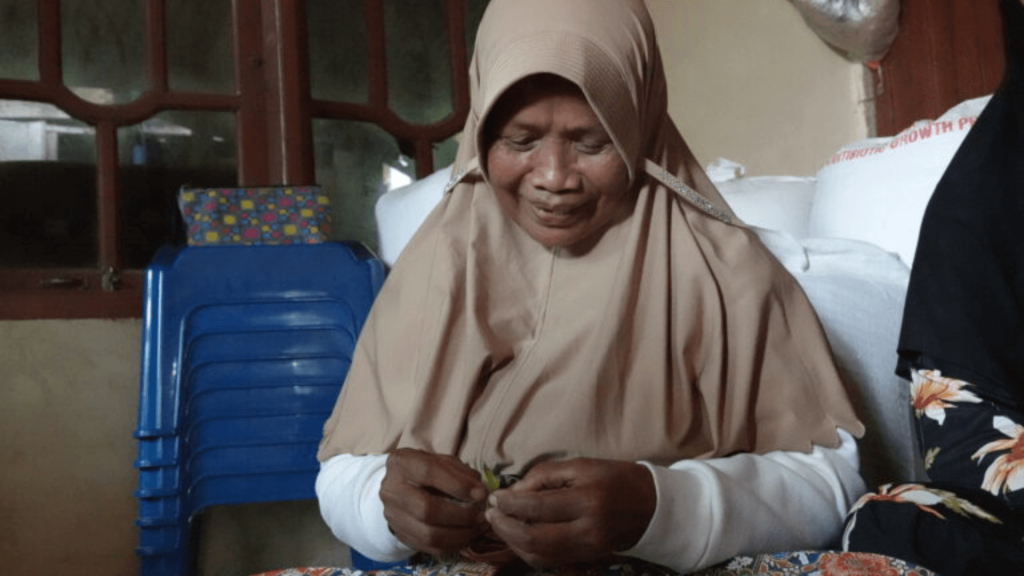
Mama Patte wraps lime in betel leaves for a customary ritual. Photo: Achmad Rizki Muazam/Mongabay Indonesia
Since reaching adulthood, Kaluppini women have been taught how to prepare ritual necessities. This knowledge is passed down from generation to generation by their parents.
Indigenous Kaluppini women also play a role in transferring customary knowledge to younger generations. Through storytelling, Kaluppini mothers teach traditions to their children.
At night, they tell stories to their children before bedtime. These stories are told in the Kaluppini language and include animal tales and ancestral stories rich in meaning.
For Mama Patte, storytelling is essential to preserving tradition. “It entertains the children, we were raised that way too, being told stories by our grandmothers. It would be embarrassing to grow old without knowing our traditions.”
Abdul Halim, the Kaluppini customary leader, said women play a dominant role in rituals. Women consistently outnumber men in attendance.
“The most influential role in these rituals is held by women,” said Imam, the customary title bestowed on Abdul Halim.
According to him, the Kaluppini Indigenous community divides roles between men and women in rituals: women prepare all ritual needs, while men lead the ceremonies.
Even so, women are often more actively involved in customary activities.
“When there is a ritual, it’s usually the women who attend. Men may still be working in the fields, but women are delegated to represent the family.”
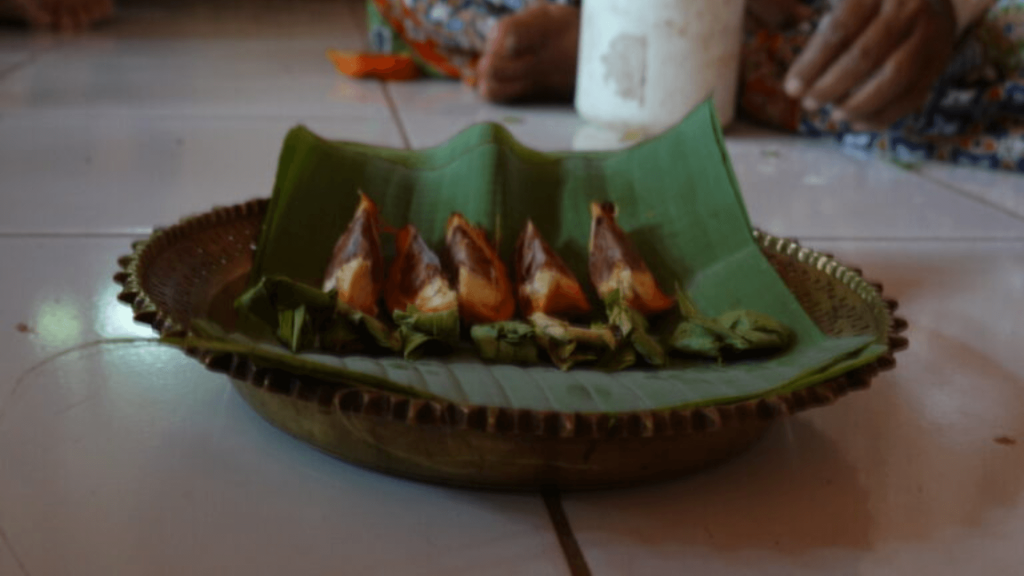
Alan nota, a Kaluppini ritual medium made from lime, betel leaves, and areca nuts. Photo: Achmad Rizki Muazam/Mongabay Indonesia
The Kaluppini community has two traditional houses located on mountain peaks, about one kilometer from the settlement, around a 30-minute walk or 10 minutes by motorcycle.
Each traditional house is guarded by a woman, one of whom is Rasi. This 80-year-old woman watches over a traditional house that frequently receives visitors.
Recently, she hosted a guest from outside Kaluppini Village who brought a chicken to be slaughtered at the traditional house. Although they were strangers, Rasi welcomed the guest warmly.
“Only during customary maulid rituals (held three times) do many guests come,” said Grandmother Rasi, as she is affectionately known.
In addition to guarding the traditional house, Grandmother Rasi can play the karumbing, a wind instrument made from sugar palm leaf sheaths. Today, few residents are skilled in playing this traditional Kaluppini instrument.
When Mongabay visited the traditional house in May, Grandmother Rasi demonstrated her ability to play the karumbing, producing a beautifully melodic sound.
She usually plays the karumbing during full moon nights to accompany customary rituals.
She is also active in teaching the karumbing to Indigenous youth. Despite being blind since birth, this has not diminished her spirit in preserving tradition.
“Children often come here to learn, especially when a festival is approaching,” she said.
In the economic sector, Indigenous Kaluppini women play a dominant role. They farm and manage household finances. Mama Hawi, for example, is a 70-year-old woman who goes to her garden every day.
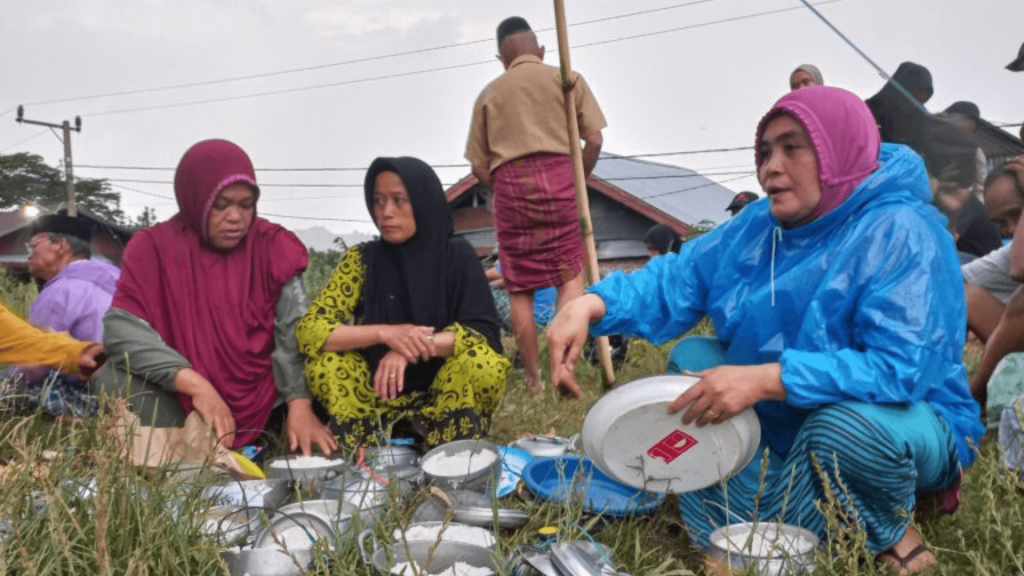
Indigenous Kaluppini women prepare food during a tolak bala ritual. Photo: Achmad Rizki Muazam/Mongabay Indonesia
She travels two kilometers from her home to reach her garden on the mountain slopes.
Mama Hawi grows rice, corn, and peanuts on approximately one hectare of land.
“Who else would take care of it if not me?” she said. All of her children have migrated out of Kaluppini.
Mama Hawi and other Indigenous Kaluppini women have full authority to decide when to plant and when to harvest. Men are not allowed to interfere in these matters.
According to Abdul Halim, Kaluppini women also play a crucial role in managing household economies. Women control family finances and income.
They also hold key roles in managing agricultural produce, such as rice and corn. “When it comes to the pabbarassang (rice storage), it is women who are in charge.”
In the social sector, Kaluppini women are also frequently involved in village deliberation meetings. Muh. Salata, Head of Kaluppini Village, said most village meetings are attended by Indigenous women. The female population is smaller than the male population, 518 women compared to 560 men.
Kaluppini women, according to Salata, actively contribute development ideas during village meetings.
“At the last village meeting in 2024, women proposed repairing the children’s playground, whose roof was close to collapsing.”
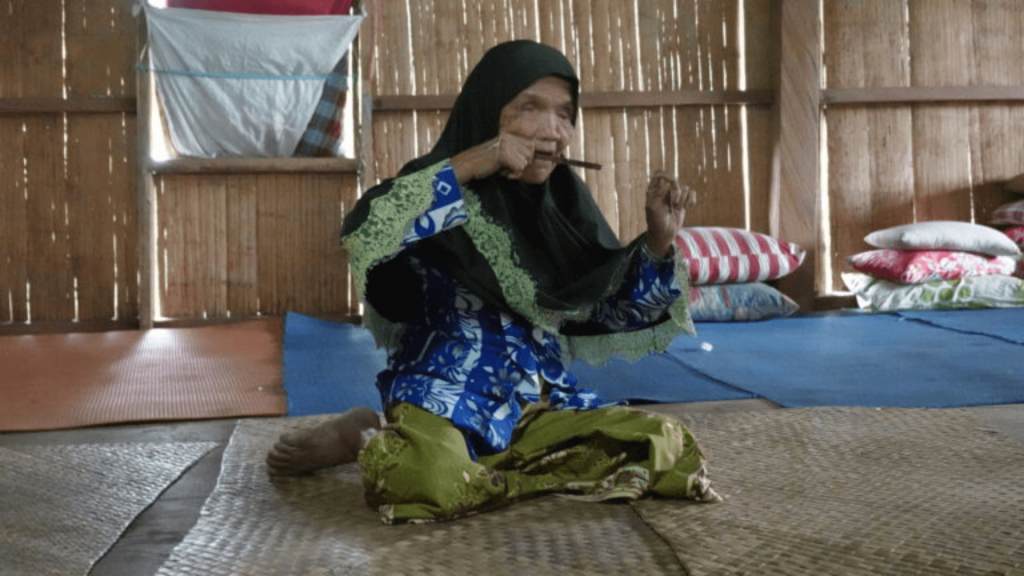
Grandmother Rasi plays the karumbing at the Kaluppini traditional house. Photo: Achmad Rizki Muazam/Mongabay Indonesia
Indigenous women’s initiatives
Isra, a young Kaluppini woman, was busy packaging palm sugar granules (gula semut). That evening, she was assisted by Ayuni in packing around five kilograms of palm sugar, totaling ten packages.
If the weather is stable and it is not the rainy season, they can produce up to seven kilograms per day.
The product is made from palm sugar that is finely filtered to resemble ant granules. They sell it for IDR 35,000 per 500 grams.
They market the product through social media and to coffee shops in Enrekang Regency.
Palm sugar granules are an economic initiative led by Indigenous Kaluppini women. Since 2023, Isra, Ayuni, and other women have established a Joint Business Group (Kelompok Usaha Bersama / KUBE) called Mabarakka Kaluppini.
“Raw materials are sufficient here. We divide tasks with the young men; they tap the palm sap,” said Isra.
A similar initiative is carried out by Sutira and other women, who have been producing bottled red ginger extract since 2019.
Each week, they can produce 10 kilograms or 20 bottles of ginger extract, sold at IDR 30,000 per bottle.
They sell the product through social media, reaching markets as far as Malaysia, Papua, and Kalimantan. The ginger extract can last up to a year without artificial preservatives.
“The ingredients are easy to find in the village, ginger grows abundantly in gardens and even in the forest. Palm sugar can also be produced locally. So this can be considered local wisdom of the Indigenous Kaluppini community,” said Sutira.
However, these women-led initiatives still face minor constraints. Palm sugar production, for instance, is limited by manual equipment, and distribution remains confined to Kaluppini.
Similarly, Sutira has yet to find the right packaging solution for ginger extract. Plastic bottles often burst when transported over long distances for extended periods.
These initiatives are not solely about economics. According to Muslimin Lancong, a facilitator from Sulawesi Cipta Forum (SCF), the involvement of Indigenous women in Kaluppini’s development aims to preserve traditional knowledge related to natural resource management and utilization.
He said Indigenous women are the primary inheritors of knowledge on resource management, traditional agriculture, herbal medicine, and various cultural practices.
“Their involvement ensures that development does not overlook local wisdom that has proven sustainable over generations,” he told Mongabay.
Women’s participation can also lead to more inclusive decision-making, ensuring that development reflects women’s needs and perspectives.
“This is essential to creating development programs that are relevant, sustainable, and fair for all segments of society,” said Muslimin.
He added that women also play a role in environmental sustainability due to their close relationship with nature, which fosters a deep understanding of local ecosystems.
According to him, women’s involvement can promote environmentally friendly and sustainable development practices.
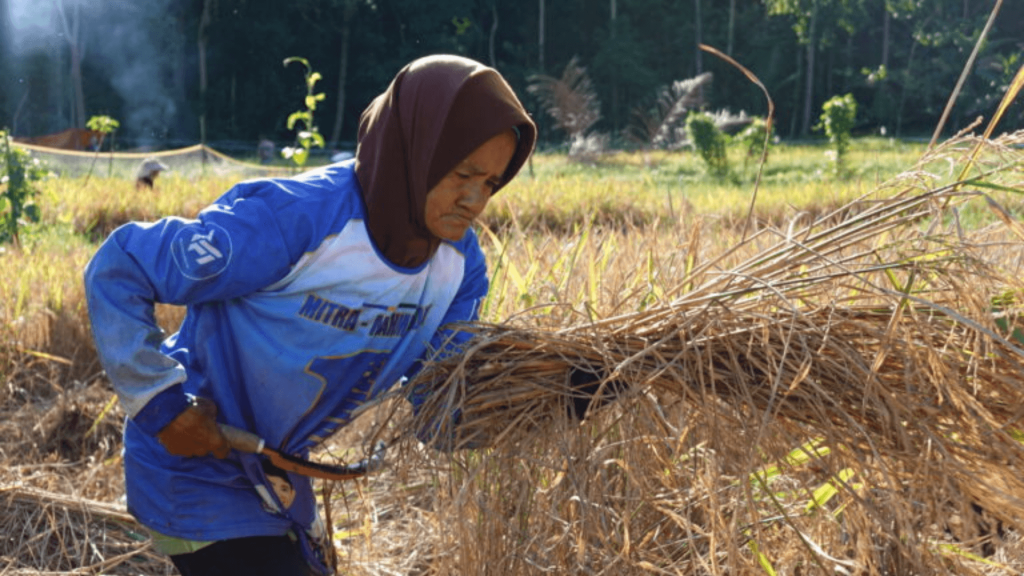
Mama Hawi harvesting rice in her family’s field. Photo: Achmad Rizki Muazam/Mongabay Indonesia
Strengthening through village regulations
Kaluppini Village, located on mountain slopes at an altitude of 900 meters above sea level, is a six-hour overland journey from Makassar, the capital of South Sulawesi.
Despite its remote location, the Kaluppini community does not neglect the role of women.
Since 2023, the Kaluppini Village Government has strengthened the role of Indigenous women through a Village Regulation (Perdes) on Gender Equality, Disability, and Social Inclusion (GEDSI).
The regulation aims to guarantee women’s rights, prevent discrimination and exploitation, and increase women’s participation.
Through this regulation, the village government has launched various women’s empowerment programs, including business groups like those formed by Isra and Ayuni.
Last January, the village government and customary leaders initiated the Sekolah Mattanun program. Kaluppini women learn to weave plain white cloth, eight meters long, which is commonly used in customary rituals.
In Kaluppini, weaving is a tradition exclusively for women. Men are considered taboo to touch weaving tools. As a result, cloth woven by Indigenous women is believed to have high spiritual value.
Muh. Salata , Kaluppini Village Head said that out of the village budget of IDR 1.19 billion, less than 10% is allocated to Indigenous women’s empowerment, disability programs, and child protection.
Outside this allocation, there is also a food sovereignty program. “They are provided with seeds, vegetables and medicinal plants to grow in their home gardens,” he said.
Recently, the central government changed policy, requiring food programs to be managed by Village-Owned Enterprises (Bumdes). The food budget allocation is IDR 140 million, or 20% of Kaluppini’s village funds.
The GEDSI Village Regulation also addresses child protection. According to Salata, the most significant change since its enactment has been the reduction of child marriage.
He said child marriage rates have dropped to zero since the Women’s Empowerment and Child Protection regulation was issued. Previously, Kaluppini was known for high child marriage rates.
“We also conduct community outreach to prevent child marriage. People are now becoming aware that quality marriages require a certain minimum age.”
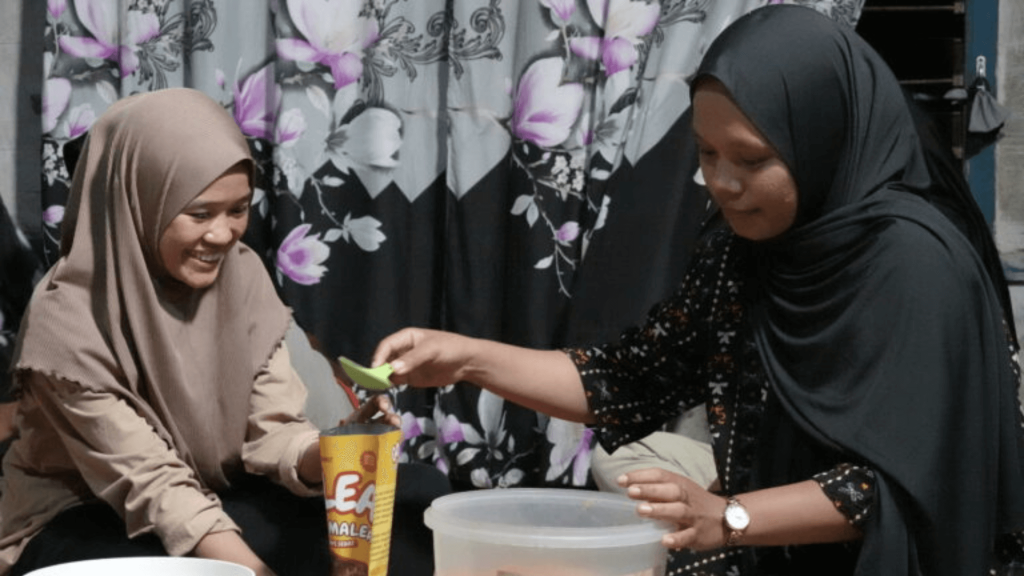
Young Kaluppini women packaging palm sugar granules. Photo: Achmad Rizki Muazam/Mongabay Indonesia
The GEDSI Village Regulation is considered crucial. Muslimin said it strengthens the protection of vulnerable groups’ rights, including women.
It also promotes equal participation of all villagers regardless of gender, disability, or social background.
“This ensures that everyone’s voices and needs are heard,” he said, noting that he has assisted the GEDSI regulation process in Kaluppini since 2023.
The GEDSI Village Regulation can also eliminate gender discrimination and inequality, practices that often occur in rural areas.
“An equitable and inclusive community tend to be stronger and more resilient in facing challenges. The GEDSI regulation helps build social cohesion by ensuring no group is left behind in development,” Muslimin said.
He added that GEDSI Village Regulations can improve the quality of village development. When development considers diverse perspectives and needs, outcomes become more comprehensive, relevant, and sustainable.
SCF, together with Kemitraan, has supported the implementation of the GEDSI regulation in Kaluppini.
Moch Yasir Sani, Program Manager at Kemitraan, views the regulation as an important achievement demonstrating the village’s commitment to inclusivity and support for vulnerable groups.
“This is a good practice born from a participatory process and dialogue among Indigenous communities, women, and the village government. We believe this model can be replicated in other villages across Indonesia.”
*****
This report is based on a media visit supported by Kemitraan in collaboration with SCF through the Estungkara program, supported by Inklusi.
Source: https://mongabay.co.id/2025/06/08/cerita-dari-kaluppini-para-perempuan-pelestari-adat/